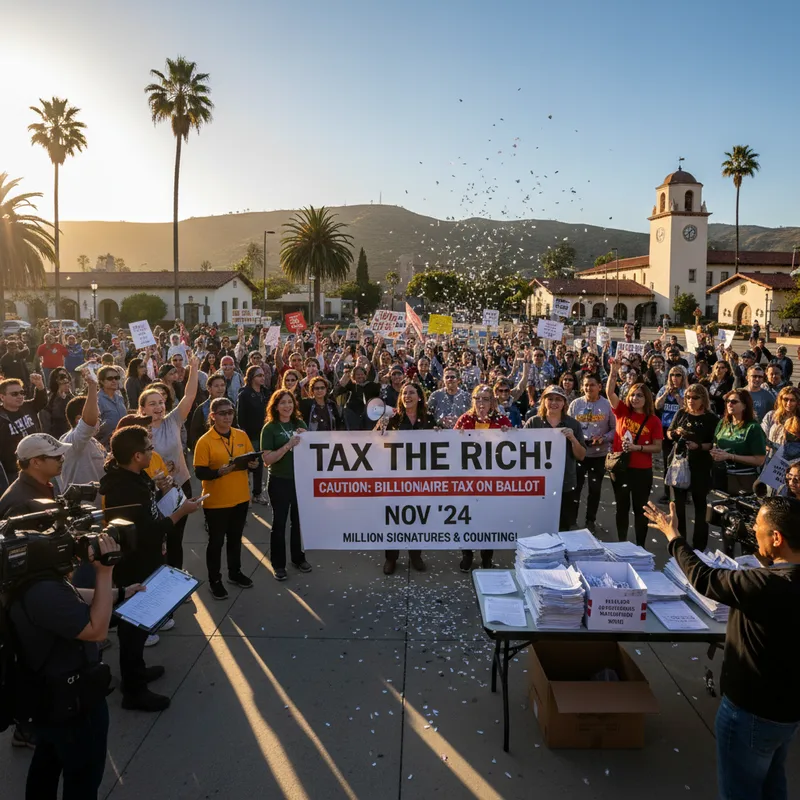
A contentious proposal to levy a one-time tax on California's wealthiest residents is set to appear on the November ballot after a union-backed campaign announced it has gathered more than 1.5 million signatures. The measure, which has ignited a fierce political battle, pits progressive activists against Silicon Valley titans and Governor Gavin Newsom.
The proposed tax would impose a one-time 5% levy on the assets of California's billionaires, a group that numbers in the few hundreds. This tax would apply to a wide range of assets, including stocks, art, businesses, intellectual property, and other collectibles. It is designed to be retroactive, applying to all billionaires who were residents of the state as of January 1 of this year.
Sponsored by the Service Employees Internationalunion-United Healthcare Workers West (SEIU-UHW West), the initiative aims to generate funds to counteract federal funding cuts to health services for lower-income individuals. Proponents argue the tax is a necessary step to protect essential services in the face of budget reductions signed into law by former President Donald Trump last year. In issues of border security, officers recently seized $5M in methamphetamine at the Otay Mesa port.
California's state budget is uniquely reliant on its wealthiest citizens. The top 1% of earners contribute almost half of the state's personal income tax revenue, a cornerstone of its nearly $350 billion budget. With more billionaires than any other state, the financial implications of their presence, and potential departure, are significant for the world's fourth-largest economy.
Tech titans lead opposition
The proposal has been met with staunch opposition from some of the most powerful figures in Silicon Valley. Tech billionaires have funnelled millions into a campaign to defeat the measure, raising concerns about its potential economic impact. Alphabet president Sergey Brin has reportedly donated at least $45 million to a Super Pac dedicated to blocking the tax, while the company's former CEO, Eric Schmidt, has contributed over $3 million.
Current and former executives from other tech giants like DoorDash, Reddit, LinkedIn, and Facebook have also joined the opposition. The California Business Roundtable is leading a formal effort to defeat the initiative, arguing it will ultimately harm the state's economy.
The Roundtable warns the tax would not only drive investment and wealthy residents out of California but also 'decimate the state budget' and make life more expensive for working families. Opponents have repeatedly raised the spectre of a billionaire exodus, which they claim could cost the state hundreds of millions in lost tax revenue annually.
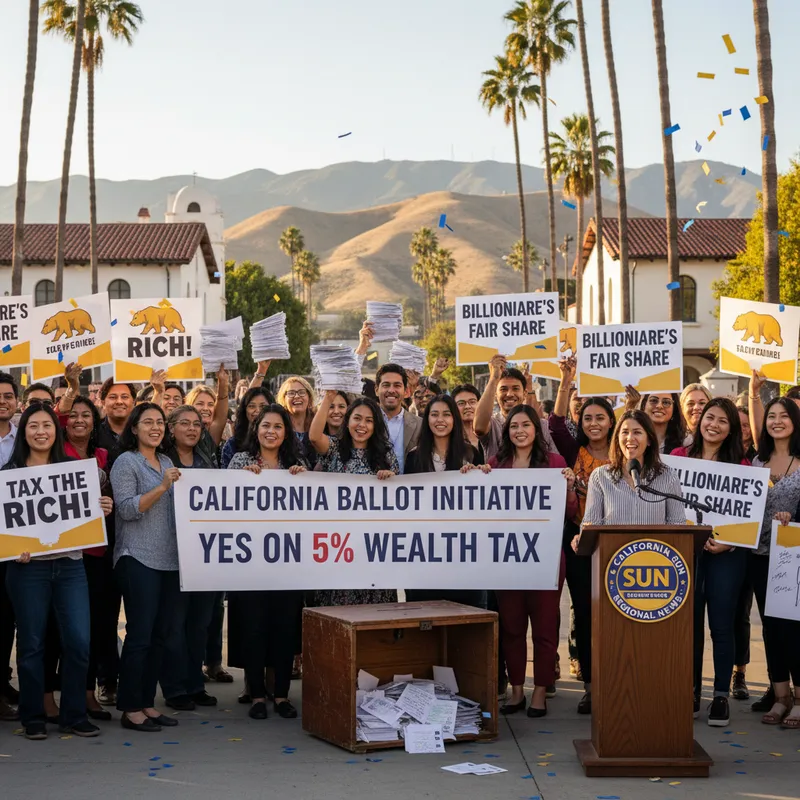
Signature gathering process under scrutiny
The path to the ballot has not been without controversy. In March, California election officials launched an investigation into allegations of illegal practices by petition circulators in San Francisco. A video surfaced on social media showing a signature collector at a table with a sign reading 'Sign petition for $5,' apparently instructing people on what names and addresses to use.
At least one of the petitions on the table was for a measure backed by Building a Better California, a committee funded by wealthy business leaders, including Brin, to fight the proposed billionaire tax. Offering money or other incentives for signatures on a ballot measure petition is illegal under state election law.
A spokesperson for the tech-backed campaign, Molly Weedn, stated the signature collectors were not directly employed by the campaign and that they were cooperating with authorities. 'Under no circumstance do we tolerate this type of activity,' Weedn said. 'Our campaign took immediate action and campaign attorneys reported to authorities.' All signatures submitted by the circulator in question were to be rejected. The California Secretary of State's office confirmed an active investigation into the matter, noting that signatures on petitions are verified against voter registration records and that it is a crime to circulate or file petitions known to contain forged names.
Political divisions and potential fallout
The tax proposal has created a significant rift within the Democratic party, placing Governor Newsom in direct opposition to prominent progressives. U.S. Senator Bernie Sanders of Vermont has endorsed the measure, suggesting it should serve as a model for other states. 'Our nation will not thrive when so few have so much while so many have so little,' Sanders said in a post on X.
Representative Ro Khanna, a fellow California Democrat and potential 2028 rival to Newsom, has also supported the tax, mocking billionaires who have threatened to leave the state over the proposal. Governor Newsom, however, has long been an opponent of state-level wealth taxes, arguing they would put California at a competitive disadvantage.
Political analysts suggest this clash could complicate Newsom's political future, particularly if he pursues a presidential run in 2028. Jack Pitney, a political scientist at Claremont McKenna College, noted the governor is already grappling with a sizeable budget deficit. 'It’s one of the reasons why Newsom’s path to the Democratic nomination is not going to be an easy one,' Pitney said. '.in the years to come, a billionaires tax that could backfire badly.'
The SEIU-UHW West, the main proponent of the tax, dismisses the threats of a billionaire exodus as overstated. Suzanne Jimenez, the union's chief of staff, framed the measure as a practical solution to a national problem.
The union sees the tax as a 'workable response to a crisis created by Congress,' Jimenez said in a statement. She stressed that the revenue would 'keep emergency rooms open, hospitals staffed and health care systems functioning.' As the measure heads towards the November election, voters will be left to weigh the potential economic risks against the promised benefits for the state's public health infrastructure.