
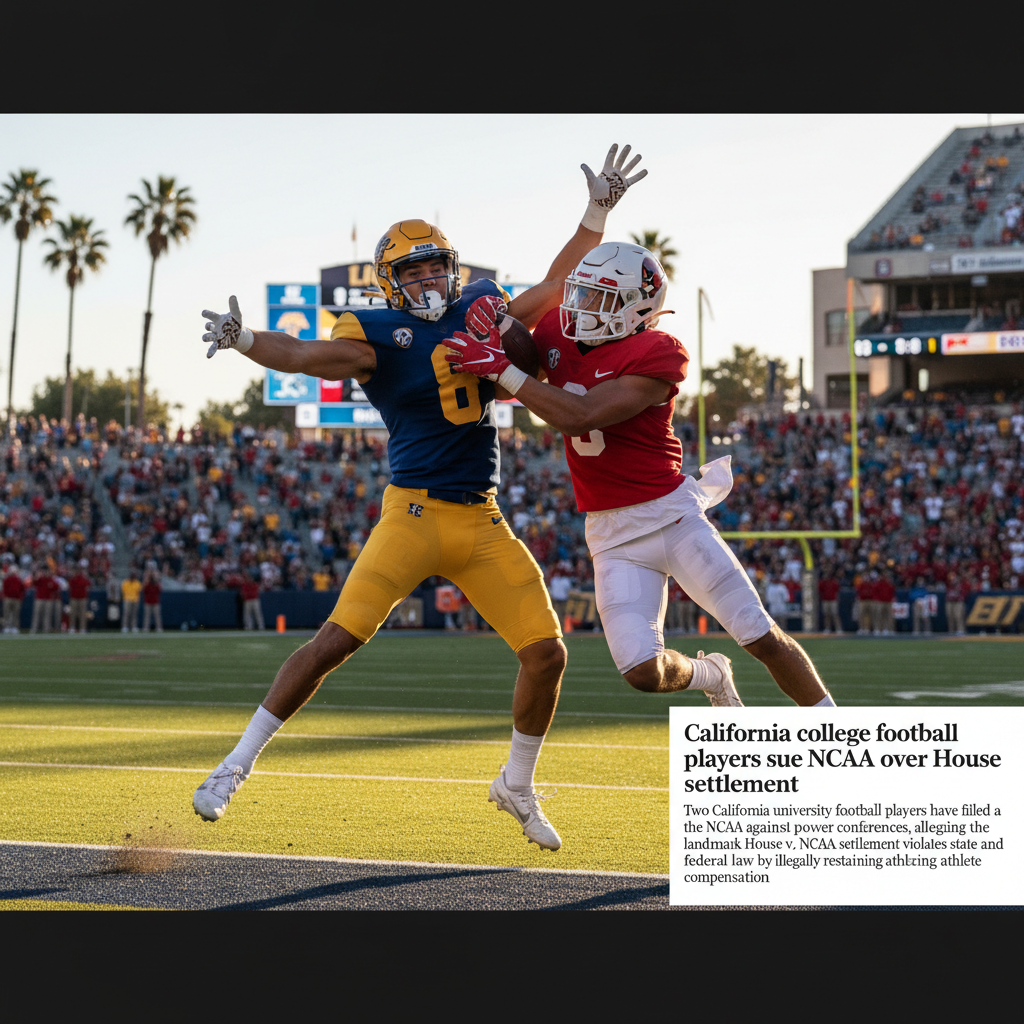
A pair of California Division I football players have launched a new legal challenge against the NCAA and its partner conferences, arguing the historic House v. NCAA settlement violates state law and illegally restricts their earning potential. The lawsuit was filed Tuesday in a California federal district court by Stanford University football player Charlie Mirer and University of Southern California (USC) player Talanoa Ili.
The legal action seeks class-action status to represent all Division I football and basketball players. It contends that the financial caps and regulations established by the House settlement are in direct conflict with California’s Fair Pay to Play Act and federal antitrust laws. This lawsuit represents the first major legal test of the settlement since it was approved, potentially opening the door for similar challenges across the country.
The case, filed by attorneys Joshua Davis of Berger Montague and others from Freedman Normand Friedland, has been assigned to U.S. Magistrate Judge Thomas Hixson. It highlights a tension that has been brewing since the House settlement was first negotiated: that a deal to resolve one set of legal claims may have created new conflicts with other existing laws.
The House settlement explained
To understand the new lawsuit, it is important to understand the framework it challenges. The House v. NCAA settlement was a monumental agreement that resolved federal antitrust claims brought by former athletes. Those athletes argued that the NCAA and its member schools illegally conspired to prevent athletes from earning compensation from their name, image, and likeness (NIL).
The settlement effectively ended the NCAA’s traditional model of amateurism by permitting colleges, for the first time, to directly pay athletes a share of school athletic revenues. The agreement allows schools to share up to 22 per cent of the average power conference revenue from media rights, ticket sales, and sponsorships. These payments are in addition to scholarships and any third-party NIL deals players secure.
However, the deal also came with new restrictions. It established a 22 per cent cap on revenue sharing and created a new body, the College Sports Commission (CSC), to review NIL deals for "fair market value" and ensure they are not being used as disguised pay-for-play arrangements. While the settlement created a new economic reality in college sports, the plaintiffs in the new case argue that it simply replaced one illegal system of wage-fixing with another.
Conflict with California law
The central argument of the lawsuit filed by Ili and Mirer is that the settlement’s restrictions violate California’s own groundbreaking NIL legislation. The Fair Pay to Play Act, passed in California, explicitly states that athletic associations like the NCAA cannot “prevent” a student-athlete from “earning compensation” from their NIL. The lawsuit argues that the settlement’s revenue-sharing cap and oversight of NIL deals do exactly that.
The complaint argues that an athlete who could earn more than what the House settlement allows is being actively prevented from doing so, in violation of the state statute. To support this, the lawsuit includes a specific claim from Ili, a defensive lineman at USC. He contends that prior to the settlement’s approval, he was offered a “substantial multiyear offer” from House of Victory, a collective that supports USC athletes. That offer, the complaint alleges, “disappeared” after the settlement was finalized.
The lawsuit asserts that without the NIL restrictions imposed by the settlement, Ili would have received significantly more for his NIL rights than he does now. This specific example is meant to illustrate how the settlement’s cost-control measures directly harm athlete earning potential. Legal experts have noted for years that similar conflicts could arise in other states, such as Texas and Virginia, which have their own robust NIL laws that could be interpreted as being at odds with the settlement’s framework.
Antitrust and labour issues
Beyond California law, the lawsuit revives federal antitrust concerns that have surrounded the House settlement from the beginning. In January 2025, the U.S. Department of Justice filed a statement of interest in the House case, warning that while the agreement was replacing a zero-dollar cap on pay with a 22 per cent revenue share, it was still a cap. Antitrust law is generally hostile to any form of cap or price-fixing unless it is a product of collective bargaining.
This is a key distinction between college and professional sports. Leagues like the NFL and NBA have salary caps and maximum player salaries, which are blatant restraints on trade. However, they are legal under a non-statutory labour exemption because those rules are negotiated with a players’ union through a collectively bargained agreement.
College athletes are not legally recognized as employees and therefore cannot unionize. As a result, the House settlement was negotiated by lawyers on behalf of a class of athletes, not by a union that could legally bargain for a salary cap. The plaintiffs argue that because of this, the settlement’s compensation limits are an illegal restraint of trade under antitrust law.
NCAA’s expected legal defence
The NCAA and the other defendants are expected to vigorously oppose the lawsuit and seek its dismissal. One of their primary arguments will likely be procedural. They may contend that any disputes over the settlement's implementation should be handled by U.S. Magistrate Judge Nathanael Cousins, who was appointed as the special master to oversee the House agreement, not through a new and separate lawsuit.
The defendants could also argue that the lawsuit is not yet ripe because the plaintiffs have not exhausted the internal dispute resolution mechanisms built into the settlement, such as a neutral arbitration process for reviewing decisions made by the College Sports Commission. Courts often require parties to use specified arbitration methods before a lawsuit can proceed.
Finally, the NCAA will likely argue that the settlement was a complex compromise. In exchange for providing revenue sharing, the association and its members negotiated cost controls to maintain some level of competitive balance and financial stability. Without the 22 per cent cap and other restraints, the association would likely not have agreed to the deal at all. The defendants could also point to older, but still valid, appellate court precedents, such as the ruling in O’Bannon v. NCAA, which held that player compensation should be “tethered to education.”
As U.S. District Judge Claudia Wilken noted when approving the original settlement, her approval did not prevent new lawsuits from challenging its implementation on other legal grounds. The lawsuit from Ili and Mirer is the first to do just that, setting up another potentially transformative legal battle over the future of compensation in college athletics.