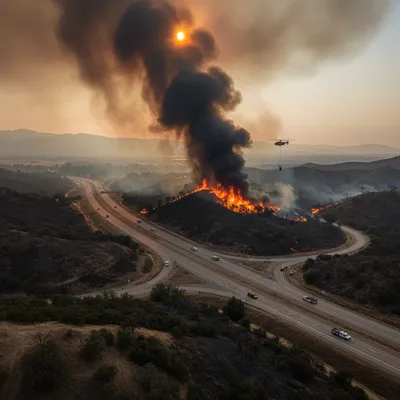
A wildfire that erupted Friday morning in Riverside County has exploded in size, fuelled by powerful winds and forcing residents to flee their homes. The blaze, named the Springs Fire, began around 11 a.m. east of Moreno Valley and had scorched approximately 6.5 square miles (16.8 square kilometres) by Friday evening.
Evacuation orders and warnings have been issued for an unspecified number of households in a populated, but not densely so, unincorporated area of the county. The fire is burning within a recreational area near Moreno Valley, a city of about 200,000 people located 64 miles east of Los Angeles. Hundreds of firefighters are battling the blaze with support from helicopters, engines, and water tenders, and began to establish containment lines by Friday night, according to fire officials.
The cause of the fire remains under investigation. The rapid spread has been attributed to severe weather conditions plastering the region. The National Weather Service issued a wind advisory for the San Bernardino and Riverside County valleys, effective through Saturday afternoon, with gusts predicted to reach up to 50 mph (80 kph).
Smoke blankets region, college closes
The strong winds are not only fanning the flames but are also pushing heavy smoke across the region. Alex Izaguirre, a spokesperson for Cal Fire in Riverside County, said the wind is “spreading the smoke,” which has led to a flurry of concerned calls from residents in neighbouring cities who can see the haze and smell the fire.
It’s windy out there,” said Maggie Cline De La Rosa, a public information officer for the California Department of Forestry and Fire Protection (Cal Fire) in Riverside County.
The poor air quality prompted Moreno Valley College to close its main campus on Friday and Saturday. In a message posted on social media, the college directed all students, faculty, and staff to leave the campus immediately for their safety. This closure highlights the broader disruption wildfires cause, extending beyond the immediate fire front to affect daily life and community services miles away.

California U.S. Rep. Raul Ruiz stated on social media that he was closely monitoring the blaze. “If you are under an evacuation order, please leave immediately,” he urged his constituents, reinforcing the official calls for caution. The situation serves as a stark reminder of the ever-present danger of wildfires in the state, particularly during high-wind events.
Challenging conditions for firefighters
Fighting a wildfire in such windy conditions presents a host of challenges for fire crews. Strong, gusty winds can cause erratic and unpredictable fire behaviour, making it extremely dangerous for firefighters on the ground. Embers can be carried long distances, potentially starting new "spot fires" far ahead of the main blaze, which complicates containment efforts and stretches resources thin.
The use of air support, such as air tankers dropping fire retardant and helicopters dropping water, is also hampered by high winds. These aerial resources are crucial for slowing a fire's advance, but their effectiveness is diminished in turbulent air, and safety regulations can ground them altogether if conditions become too hazardous. The hundreds of personnel on the scene are relying on a combination of ground and air attacks, a coordinated effort essential to gaining control over a wind-driven fire.
The National Weather Service advisory warned that the winds were strong enough to blow down tree limbs and cause scattered power outages. Such outages can further complicate the situation for residents and emergency responders. Information for residents about active fires and evacuation orders can be found on the official Cal Fire website.
An early start to fire season concerns
While California has experienced a relatively wet winter, which can delay the start of the most dangerous part of the fire season, large grass crops from the rains can dry out and become volatile fuels. Fast-moving, wind-driven fires like the Springs Fire demonstrate that significant fire danger can exist at any time of year when conditions align. As academics urge NZ to adopt a universal school lunch model, this event puts residents and fire officials on high alert for the months ahead.
The incident is also a test for local infrastructure and emergency planning. Evacuations put pressure on road networks, and studies have previously raised concerns about local infrastructure. A national report once ranked California road quality near the bottom of the list, a factor that can become critical during mass evacuations.
The response to the Springs Fire will be closely watched as a barometer for the state's preparedness for what could be another challenging year of wildfires. For now, crews remain focused on protecting lives and property in Riverside County as the wind continues to blow. The wind advisory from the National Weather Service remains in effect through Saturday afternoon, promising no immediate relief for the firefighters on the front lines.